
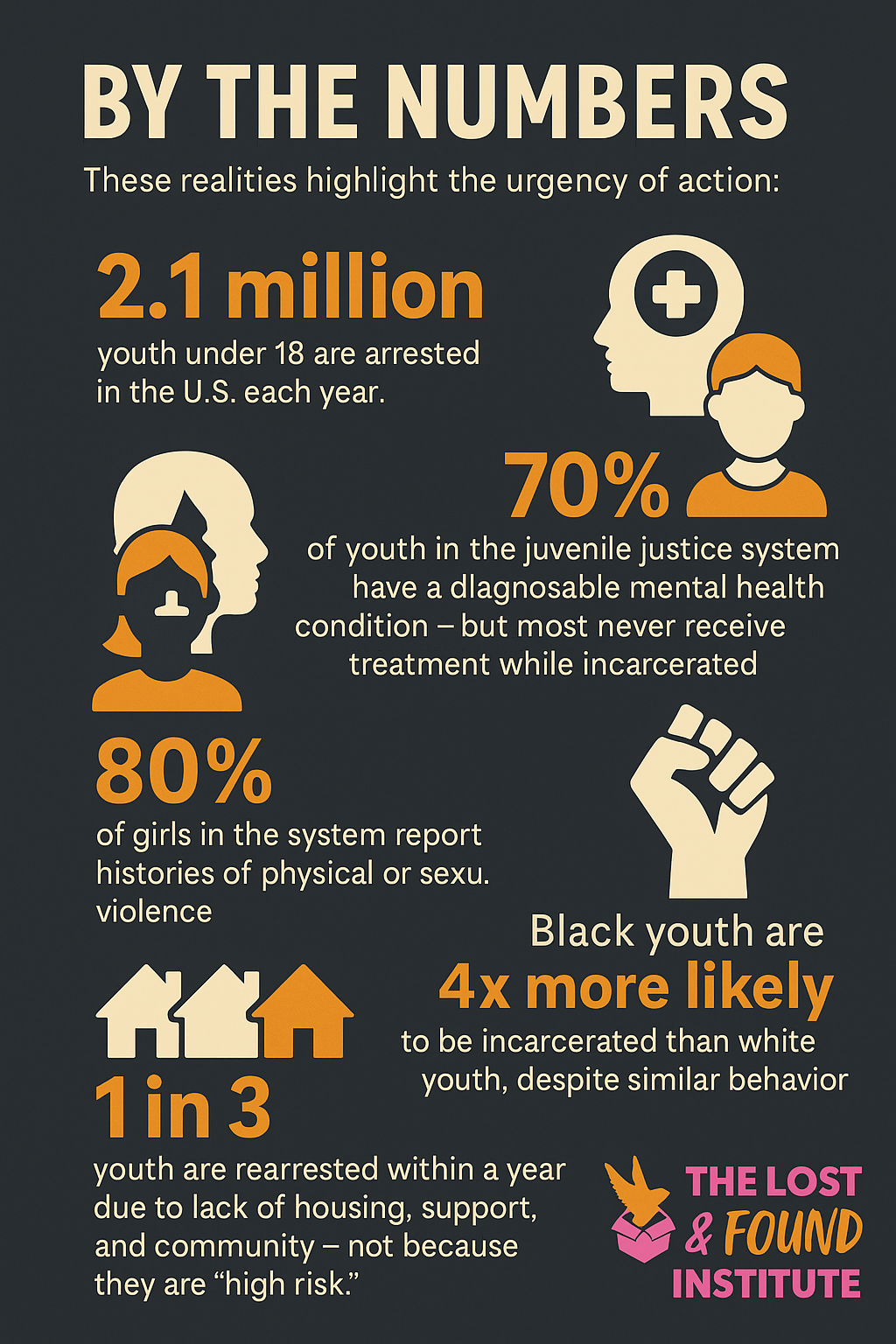
The recidivism rate for youth in the juvenile justice system is nearly 55% at 12 months post-release, according to the Office of Juvenile Justice and Delinquency Prevention. In many states, up to 80 % of the youth who are incarcerated are rearrested within 3 years of release.
Juvenile Justice: Confronting Harm, Centering Healing, and Reimagining Safety
Every year, millions of young people encounter the juvenile justice system — not because they are dangerous, but because they are unheard, unsupported, and navigating trauma without resources.
Behind every charge is a story of survival, community violence, family instability, unmet mental health needs, or system involvement long before the courtroom.
At The Lost & Found Institute, we believe young people deserve care, compassion, and healing, not cages. We work to transform the juvenile justice system by centering lived experience, building community, and creating pathways to liberation.
Understanding Juvenile Justice
The juvenile justice system was created to rehabilitate youth — but today, it often functions as a pipeline pushing young people deeper into punishment and isolation.
Young people are:
Detained for behaviors tied to trauma, poverty, or survival
Criminalized for school-based incidents that could be resolved with support
Forced into facilities far from home, culture, and community
Labeled and judged before they are heard
Navigating courts and probation systems without stability or advocacy
Funneled between foster care, schools, behavioral programs, and detention
Instead of offering care, the system often reinforces trauma — especially for youth of color, LGBTQ+ youth, youth in poverty, and youth with foster care histories.
Survival should never be criminalized.
Youth deserve support, not system harm.
What Juvenile Justice Feels Like from the Inside
Court dates.
Probation demands.
Detention centers with bright lights and locked doors.
Phone calls that cost too much.
Adults who talk about you instead of to you.
Young people describe justice involvement as:
Being punished for trauma no one asked about
Feeling unheard, unseen, or misjudged
Trying to stay stable while moving through facilities
Being separated from siblings, caregivers, and community
Carrying labels that follow them long after release
“I was fighting to survive, not to be criminalized.”
— Youth, formerly incarcerated
“They saw my file, not my reality.”
— System-impacted teen
Cages don’t create safety.
Connection does.
When Systems Collide
Justice involvement rarely happens alone — it sits at the intersection of multiple systems:
Juvenile Justice + Foster Care
Youth with 5+ placements or group home histories are significantly more likely to be detained.
Juvenile Justice + Mental Health
Unmet behavioral health needs lead to charges, not care.
Juvenile Justice + Schools
Suspensions, expulsions, and policing in schools push youth into courts (“the school-to-prison pipeline”).
Juvenile Justice + Poverty
Fees, fines, transportation barriers, court requirements, and supervision demands disproportionately impact youth in poverty.
Juvenile Justice + Racial Justice
Black, Indigenous, and Latine youth face significantly harsher treatment at every decision point.
To address juvenile justice, we must address the systems that feed it.
Resources:
The Annie E. Casey Foundation, JUVENILE DETENTION EXPLAINED blog
