
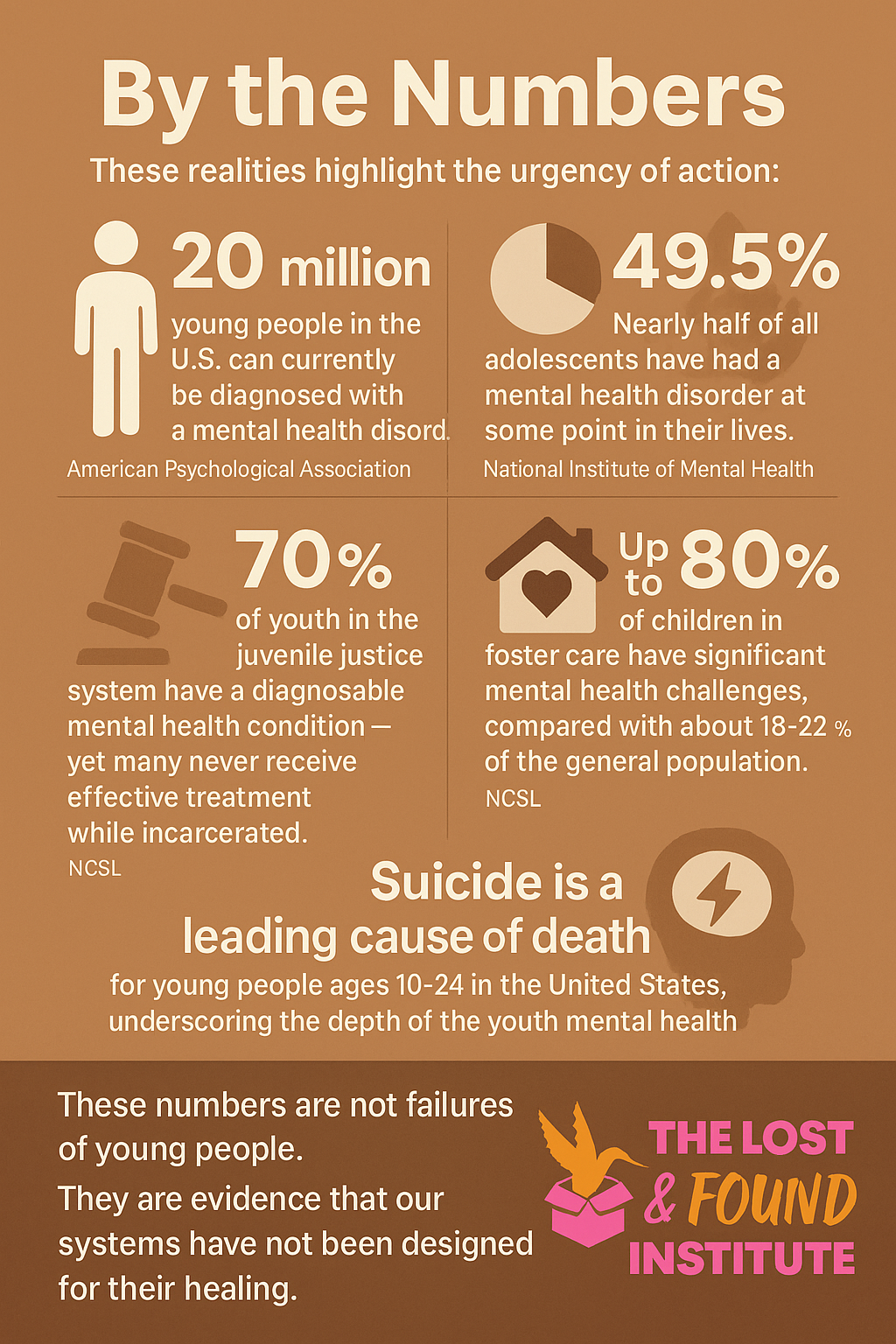
An estimated 20 million of our nation’s young people can currently be diagnosed with a mental health disorder.
Mental & Behavioral Health: Honoring Our Minds, Bodies, and Spirits
An estimated 20 million of our nation’s young people can currently be diagnosed with a mental, emotional, developmental, or behavioral disorder.
But these numbers don’t tell the whole story.
For many system-impacted youth, “mental health” is not just about diagnoses. It is about surviving violence, racism, family separation, foster care, incarceration, homelessness, and poverty — often all at once. It’s about learning to cope in a world that rarely feels safe, and then being labeled “disruptive,” “defiant,” or “broken” for how that pain shows up.
At The Lost & Found Institute, we believe mental and behavioral health are about wholeness, not worthiness. Every young person deserves access to care, community, and practices that help them feel grounded, seen, and loved.
Understanding Mental & Behavioral Health
Mental and behavioral health challenges among youth are shaped by many overlapping forces:
Exposure to adversity and trauma — including abuse, neglect, community violence, and family instability
System involvement — foster care, juvenile or criminal legal systems, residential treatment, and congregate care
Poverty and instability — housing insecurity, food insecurity, and lack of transportation or healthcare
Oppression and stigma — racism, sexism, homophobia, transphobia, ableism, and adultism
Isolation and lack of belonging — losing connection to family, culture, language, school, or community
When youth carry all of this, their reactions are often normal responses to abnormal conditions. Yet instead of receiving care, many are punished, pathologized, or criminalized.
We work to flip that script — from “What’s wrong with you?” to “What happened to you, and how can we support your healing?”
What Mental & Behavioral Health Feels Like from the Inside
For system-impacted youth and young adults, mental and behavioral health struggles can feel like:
Carrying panic, rage, or grief that no one has time to sit with
Being told to “be resilient” while basic needs go unmet
Having trauma responses described as “bad behavior”
Being over-medicated, restrained, or isolated instead of supported
Fearing that speaking up will lead to punishment, removal, or hospitalization
Feeling invisible in school, court, or treatment settings that don’t reflect their culture or lived experience
“They kept asking what was wrong with me. No one asked what had happened to me.”
— Youth with lived experience in care and confinement
Healing becomes possible when youth are met with curiosity instead of judgment, choice instead of control, and community instead of isolation.
If You’re Struggling Right Now
If you or someone you love is in crisis, you deserve immediate support:
988 Suicide & Crisis Lifeline – Call or text 988, or chat via 988lifeline.org
If you’re in immediate danger, call 911 or go to the nearest emergency room.
You are not a burden. Your feelings matter. You deserve care.
Content Note
This page includes mention of trauma, mental illness, and suicide. Please take care of yourself as you read. You can pause, breathe, or step away and return when you’re ready. You are not alone in this.
How Mental & Behavioral Health Intersects with Other Systems
Mental and behavioral health challenges rarely show up alone — they are deeply connected to other issues The Lost & Found Institute works on:
Foster Care
Complex trauma, placement changes, and broken relationships make mental health needs both more common and less likely to be treated. Many youth in care never receive consistent, culturally responsive therapy.Juvenile & Criminal Justice
Unmet mental health needs often become criminalized. Youth are detained for behaviors rooted in trauma, grief, or survival rather than connected to care.Homelessness
Housing instability worsens mental health symptoms, and mental health challenges can make it harder to keep housing, school, or employment.Human Trafficking & Exploitation
Survivors often live with PTSD, depression, anxiety, and dissociation — yet face stigma, disbelief, and systems that prioritize control over healing.
To truly support mental and behavioral health, we must change the conditions that create so much distress — not just treat the symptoms.
Resources:
American Psychological Association
https://www.apa.org/topics/children/mental-health
Youth.gov
https://youth.gov/youth-topics/prevalence-mental-health-disorders-among-youth
National Alliance on Mental Illness
U.S. Department of Health and Human Services
https://opa.hhs.gov/adolescent-health/mental-health-adolescents
